- Free Consultation*: 404-253-7862 Tap Here To Call Us










Femur Fracture Injuries


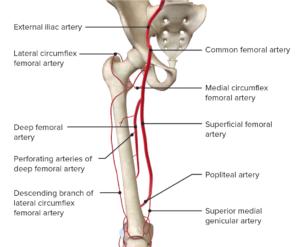
Femur fracture injuries are serious, painful, and often cause some degree of permanent impairment. Your femur (thigh bone) is the longest, thickest, and biggest bone in your body. It takes a lot of force to break the femur. A femur fracture may involve a break, crack, or crush injury of the bone. Auto and truck collisions are the most common cause of femur fractures.
The long, straight part of the femur is called the femoral shaft. Femur fracture injuries anywhere along this length of bone is called a femoral shaft fracture. Fractures that break completely through the bone, or cause the bone to be displaced or crushed, require immediate surgery. These are classified in several ways:
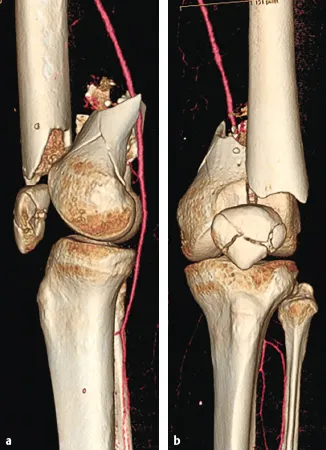
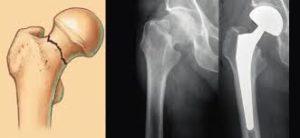
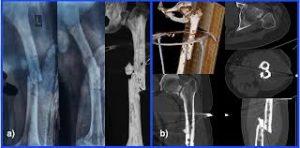
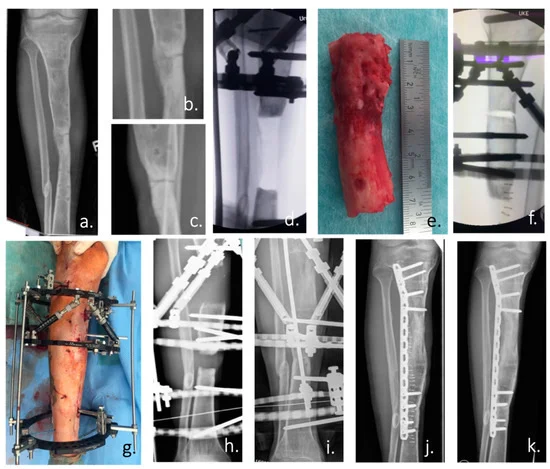
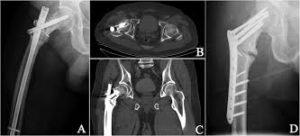
- Stable fracture: fragments of the broken bone line up correctly.
- Displaced fracture: broken bone fragments are out of alignment and must be put back in line.
- Closed fracture: the skin around the fracture remains be intact
- Open fracture: the broken bone has punctured the skin.
- Location of fracture:
- Distal: near the knee
- Middle: the long middle stretch of the femur
- Proximal: in the femoral head or neck where the femur joins to the hip. This is a major cause of disability and the decline of older people.
- Pattern of fracture
- Transverse fracture: a break is a straight horizontal line across the femoral shaft.
- Oblique fracture: a break is an angled line across the shaft.
- Spiral fracture: Twisting force causes a fracture line that spirals around the shaft like stripes on a barber pole or candy cane.
- Comminuted fracture: bone has broken into three or more pieces.
- Open or compound fracture: bone fragments stick out through the skin or a wound penetrates down to the broken bone, the fracture is called an open or compound fracture. This involves increased damage to the surrounding muscles, tendons, and ligaments, and higher risk for complications—especially infections—and take longer to heal.
Femoral fractures often require complex surgery. When a surgeon opens up the thigh to put bone fragments back in proper alignment that is call “open reduction.” That contrasts with “closed reduction” in which a surgeon is able to align bones fragments without cutting. When the surgeon uses rods (also called nails), screws and other hardware to secure the fragments together, that is called “internal fixation.” The entire procedure is “open reduction – internal fixation,” abbreviated as “ORIF.” Rods (nails) inserted in the middle of the femoral shaft and secured with screws, plates, and wires. This internal hardware is usually left in the body long-term.
Some also required external fixation devices temporarily on the outside of the thigh. Complications may arise if these devices are misaligned in any way, or with infection, nerve damage, blood clots, and bones setting in incorrect positions. Sometimes more than one operation is required.
We have handled many cases involving complex femur fractures, working closely with treating orthopedic surgeons to accurately communicate the full reality of such injuries, including impairment ratings, disability factors, and custom medical illustrations.
In one femur fracture case arising from a truck wreck in a conservative, rural Georgia county, Ken Shigley obtained a jury verdict of $2,345,940.17, roughly $1.2 million more than we asked for. That was the result of providing the jury a method of determining value in such a manner that the jurors decided to award more than the amount that we asked for in closing arguments.
If you or a loved one has suffered a femur fracture due to a truck crash or other traumatic injury, call us at 404-253-7862.
Johnson & Ward has been a leading personal injury specialty law firm in Atlanta since 1949.
Ken Shigley is a former president of the State Bar of Georgia (2011-12), triple board certified by the National Board of Trial Advocacy, recipient of the Traditions of Excellence Award for lifetime achievement, and was lead author of Georgia Law of Torts: Trial Preparation and Practice (2010-21). He graduated from Furman University and Emory University Law School.
John Adkins specializes in personal injury and wrongful death litigation. He is an honor graduate of Kennesaw State University and Thomas Jefferson School of Law in San Diego.
Ed Stone specializes in personal injury and wrongful death litigation. He is a graduate of Kennesaw State University and John Marshall Law School in Atlanta.