

Readiness for Trial Is the Key to a Fair Settlement






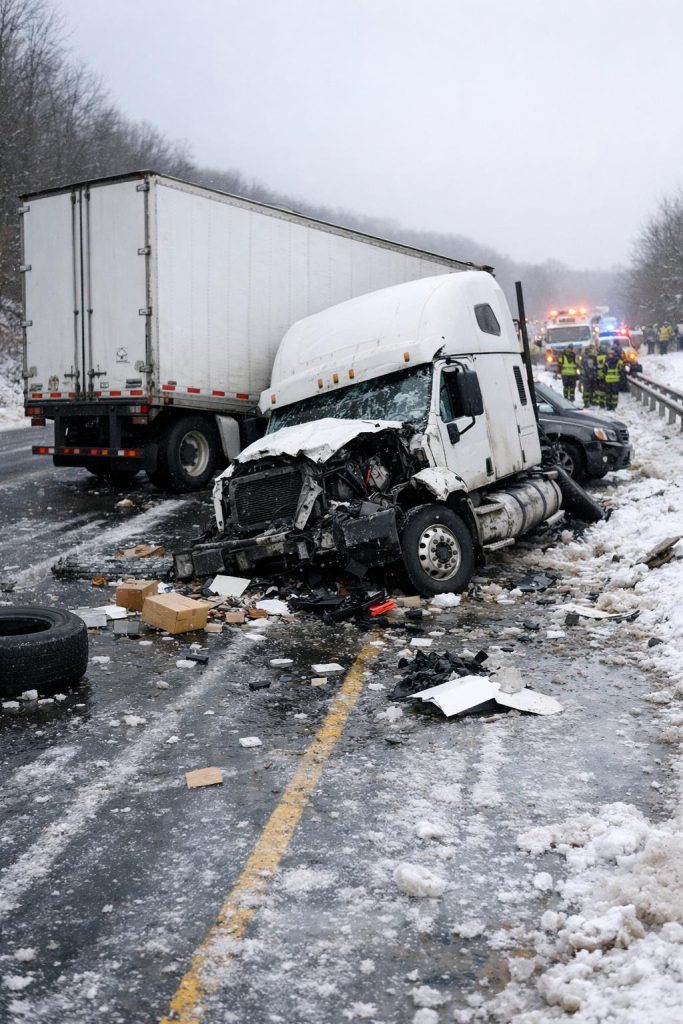
Truck accidents in bad weather in Georgia
You may have had the experience of being passed by a tractor trailer speeding in heavy rain, snow or ice. If so, you understand the reason for the “extreme caution” rule that trucker was ignoring.
F.A.Q. Are truck drivers required to exercise “extreme caution” in hazardous weather?
Commercial truck drivers must use extreme caution when weather or road conditions reduce visibility or traction. This heightened duty sits on top of Georgia’s general ordinary care standard and requires professional drivers to slow down and, when necessary, stop until it is safe to continue. Also see our Trucking Accidents information page.
F.A.Q. What is the “extreme caution” rule in the Federal Motor Carrier Safety Regulations and Georgia Commercial Drivers License Manual?
49 C.F.R. § 392.14 is a federal trucking regulation that requires commercial drivers to:
- Exercise extreme caution when hazardous conditions such as snow, ice, sleet, fog, mist, rain, dust, or smoke adversely affect visibility or traction.
- Reduce speed when such conditions exist.
- Discontinue operation if conditions become sufficiently dangerous and not resume until the vehicle can be safely operated.
This is explained in practical detail in the Commercial Drivers License manuals of all fifty states.
If stopping would itself increase danger to passengers, the rule allows the driver to proceed only to the nearest location where their safety is assured.
F.A.Q. Does this “extreme caution” rule apply to truck drivers in Georgia?
Yes. The extreme caution rule applies to interstate motor carriers operating in Georgia, and parallel standards are applied to most intrastate (within Georgia) commercial trucking as well. Georgia’s CDL training materials and common industry practice expect drivers to follow the same heightened precautions in hazardous weather.
F.A.Q. How does Georgia’s ordinary care standard interact with the federal extreme caution rule?
Georgia negligence law uses an ordinary care standard—what a reasonably prudent person would do in similar circumstances. For truckers, the federal extreme caution rule and CDL guidance help define what “reasonable” means when visibility or traction is compromised. In practice:
- The jury still applies Georgia’s ordinary care standard.
- The federal rule supplies a higher, situation‑specific benchmark for professional drivers.
- A proven violation of the extreme caution rule can be powerful evidence that the driver failed to use ordinary diligence under Georgia law.
F.A.Q. What does the Georgia Commercial Drivers License Manual say about driving in bad weather?
The Georgia Commercial Driver’s License Manual gives concrete examples of how a commercial driver should slow down in adverse conditions, such as:
- On wet roads: Reduce speed by about one‑third (for example, from 55 mph to around 35 mph).
- On packed snow: Reduce speed by about one‑half or more.
- On ice: Slow to a crawl and stop driving as soon as you can do so safely.
These guidelines show jurors what extreme caution should look like on the road.
F.A.Q. Is violating 49 C.F.R. § 392.14 the same as negligence per se?
Typically, a violation of the extreme caution rule is treated as strong evidence of ordinary negligence, not negligence per se. The regulation helps define the duty of care for commercial drivers in specific hazardous conditions. If a driver ignores that duty—by failing to slow, failing to pull over, or continuing at normal highway speeds in poor conditions—a jury may consider that as proof of a breach of the standard of care.
F.A.Q. Can a Georgia jury be instructed on the extreme caution rule?
Yes. Courts in some jurisdictions have held that it can be reversible error for a trial court to refuse to instruct the jury on the extreme caution regulation when hazardous weather and commercial vehicle operation are supported by the evidence. In those cases, appellate courts emphasize that juries should hear the correct standard for professional drivers in bad weather, not just a generic “ordinary care” charge. However, due to murky case law on what is considered “negligence per se,” a more cautious course for your lawyer may be get the truck driver and safety manager to admit that the Commercial Driver Manual spells out the accepted industry standard of care for commercial truck drivers.
F.A.Q. How does the extreme caution rule help in a Georgia truck accident case?
In a trucking case involving rain, fog, ice, or other adverse conditions, the extreme caution rule can:
- Show that a professional driver had a specific, heightened duty to slow down or stop.
- Undercut “it was just bad weather” defenses by focusing on the driver’s choices rather than the storm.
- Support claims that the driver and carrier failed to follow recognized industry safety standards.
- Help persuade the court to give a jury instruction on the heightened duty owed by commercial drivers in hazardous conditions.
This is particularly important under Georgia’s modified comparative negligence system, where a plaintiff’s damages can be reduced by their percentage of fault and barred entirely if they are 50% or more at fault. Demonstrating that the truck driver ignored the extreme caution requirement can shift more responsibility to the driver and carrier and blunt arguments that the plaintiff was primarily to blame.
F.A.Q. Do trucking companies have a duty to train drivers on the extreme caution standard?
Yes. Although this is supposedly touched upon in CDL training courses, trucking companies are expected to know and enforce both federal and state safety rules. Their duties typically include:
- Training drivers on 49 C.F.R. § 392.14 and related CDL guidance.
- Instructing drivers on when and how to reduce speed or stop in hazardous weather.
- Monitoring, correcting, and disciplining drivers who ignore bad‑weather safety rules.
When a company fails in these responsibilities, an injured person may bring claims for negligent hiring, training, supervision, or entrustment in addition to negligence claims against the driver.
F.A.Q. What kinds of hazardous conditions trigger the extreme caution rule?
The regulation and CDL manuals describe a range of conditions that can require extreme caution, including:
- Snow, sleet, or packed snow on the roadway.
- Ice or black ice.
- Heavy rain or standing water that increases hydroplaning risk.
- Fog, mist, smoke, or dust that limits visibility.
- High winds or other conditions that affect control, traction, or stopping distance.
The core questions are whether visibility or traction are adversely affected and whether a reasonably prudent commercial driver would substantially reduce speed or discontinue travel.
F.A.Q. How do you prove a violation of 49 C.F.R. § 392.14 in a Georgia court?
Proving a violation usually involves two steps.
- Establish hazardous conditions.
Show that conditions adversely affected visibility or traction using:- Weather records, radar and forecast data.
- Police reports describing road and weather conditions.
- Photos, dash‑cam footage, and scene video.
- Eyewitness and client testimony about visibility, road slickness, and how other drivers reacted.
- Get the driver and safety manager to admit on cross examination in depositions that “extreme caution” is a rule they must follow in adverse weather conditions.
- Show the driver failed to use extreme caution.
Compare what the driver actually did with what the rule and Georgia CDL guidance require, relying on:- Electronic control module (“black box”) and electronic log data showing speed, braking, and whether the driver slowed or stopped.
- GPS and telematics data tying speed and location to the weather at the time.
- Dash‑cam or nearby surveillance video capturing the truck’s movement in the conditions.
- Company policies and training materials showing what the driver was supposed to do in bad weather.
If admissions by the defendants in deposition leave gaps, expert testimony from trucking‑safety, reconstruction, and meteorology professionals helps tie these facts together and explain to the jury how the driver’s conduct fell short of the extreme caution standard and contributed to the crash.
F.A.Q. What expert witnesses are used in weather‑related trucking negligence cases?
Weather‑related trucking cases often rely on several types of expert witnesses, including:
- Forensic meteorologist
Reconstructs the weather at the crash location and time, explains visibility, precipitation, and surface conditions, and addresses whether hazards were foreseeable. - Trucking safety / FMCSR expert
Interprets federal regulations and CDL standards, reviews logs and company policies, and opines on whether the driver and carrier complied with the extreme caution duty. - Accident reconstruction expert
Uses physical evidence, vehicle damage, and electronic data to show how speed, visibility, and traction interacted and whether a slower speed or shutdown would likely have avoided the crash. - Human factors expert
Analyzes perception‑reaction time, sight distance in fog or rain, and what an attentive commercial driver should have perceived and done. - Mechanical/vehicle systems expert
Evaluates brakes, tires, and other systems to determine whether mechanical issues played a role or magnified the risk. - Medical and damages experts
Connect the crash to the client’s injuries, future care needs, functional limitations, and economic losses.
F.A.Q. Does federal law preempt Georgia’s ordinary care standard in these cases?
The federal extreme caution rule effectively sets a higher floor for how a commercial driver must act in hazardous conditions. Georgia’s ordinary care standard still governs negligence claims, but:
- Truck drivers must at least meet the protections required by federal law.
- A driver cannot defend by saying that ordinary care under state law allowed more leeway than the federal rule.
- The federal regulation and industry standards shape what a reasonable professional driver must do when visibility or traction are compromised.
In practical terms, a commercial driver operating in Georgia is expected to comply with 49 C.F.R. § 392.14 even where a generic ordinary care standard might seem less demanding.
F.A.Q. How does this affect fault and damages in a Georgia truck case?
Georgia uses a modified comparative negligence system with a 50% bar rule. That means:
- The jury assigns percentages of fault to everyone involved.
- A plaintiff’s damages are reduced by their percentage of fault.
- If the plaintiff is 50% or more at fault, they recover nothing.
Evidence that a truck driver ignored the extreme caution rule—driving too fast for conditions, failing to slow or stop, or pushing through dangerous weather—can increase the share of fault assigned to the driver and carrier and reduce the impact of arguments that the plaintiff was primarily responsible.
F.A.Q. What should I do if I was hurt in a Georgia truck wreck during bad weather?
If you were injured in a collision with a tractor‑trailer or other commercial vehicle in rain, fog, ice, or similar conditions, you should:
- Get immediate medical evaluation and follow all treatment recommendations.
- Preserve photographs, dash‑cam video, vehicle data, and contact information for witnesses as soon as possible.
- Avoid giving recorded statements to insurance adjusters before talking with an attorney.
- Contact a Georgia truck accident lawyer who understands federal motor carrier safety rules, including 49 C.F.R. § 392.14, and knows how to use the extreme caution standard and expert testimony to build your case.
A skilled attorney can secure crucial electronic data, weather records, company safety materials, and expert opinions to show how the driver and carrier failed to meet their heightened safety duties in hazardous conditions.
If you or someone you love has been injured in a truck crash in or around Atlanta, prompt, informed legal guidance can make a substantial difference in both the outcome and the peace of mind you experience during a difficult time.
Johnson & Ward, established in 1949, was Atlanta’s first personal injury specialty law firm. Call today at (404)253-7862 to schedule a free consultation. We handle car and truck accidents, falls, and serious injury claims, and we only get paid if we win.
Reviewed February 25, 2026 by:
Ken Shigley, senior counsel, former president of the State Bar of Georgia, was the first Georgia lawyer to earn three board certifications from the National Board of Trial Advocacy: Truck Accident Law, Civil Trial Practice, and Civil Pretrial Practice. He was the lead author of eleven editions of Georgia Law of Torts: Trial Preparation and Practice, and received the Traditions of Excellence Award from the State Bar of Georgia General Practice and Trial Section. B.A., Furman University; J.D., Emory University Law School; Certificates in mediation and negotiation, Harvard Law School.
John Adkins, managing partner, experienced in personal injury law, including auto accidents, truck accidents, wrongful death, workers’ compensation, premises liability claims, dangerous or defective products, medical malpractice, and related Plaintiff’s tort litigation. B.A., magna cum laude, Kennesaw State University; J.D., Thomas Jefferson Law School.
Ed Stone, partner, personal injury law, including truck accidents, auto accidents, wrongful death, workers’ compensation, premises liability claims, dangerous or defective products, medical malpractice, and related Plaintiff’s tort litigation. B.B.A., Kennesaw State University; J.D., John Marshall Law School.