

Readiness for Trial Is the Key to a Fair Settlement











Tire and wheel off trucking accidents in Georgia
People often use “tire-off” and “wheel-off” interchangeably, but the cause and evidence can differ. If you or a family member were injured in a “tire-off” or “wheel-off” truck accident, you may have claims against more than just the truck driver and the trucking company that employed him. In many cases, liability may also involve the trailer owner, maintenance contractor, tire shop, or parts manufacturer. See also our trucking acicdnets information page.
See also truck accident information center and information on dump truck accidents, log truck accidents,, truck accidents in bad weather, and reasons to file a truck accident case in Georgia.
F.A.Q. What is a tire-off or wheel-off truck accident?
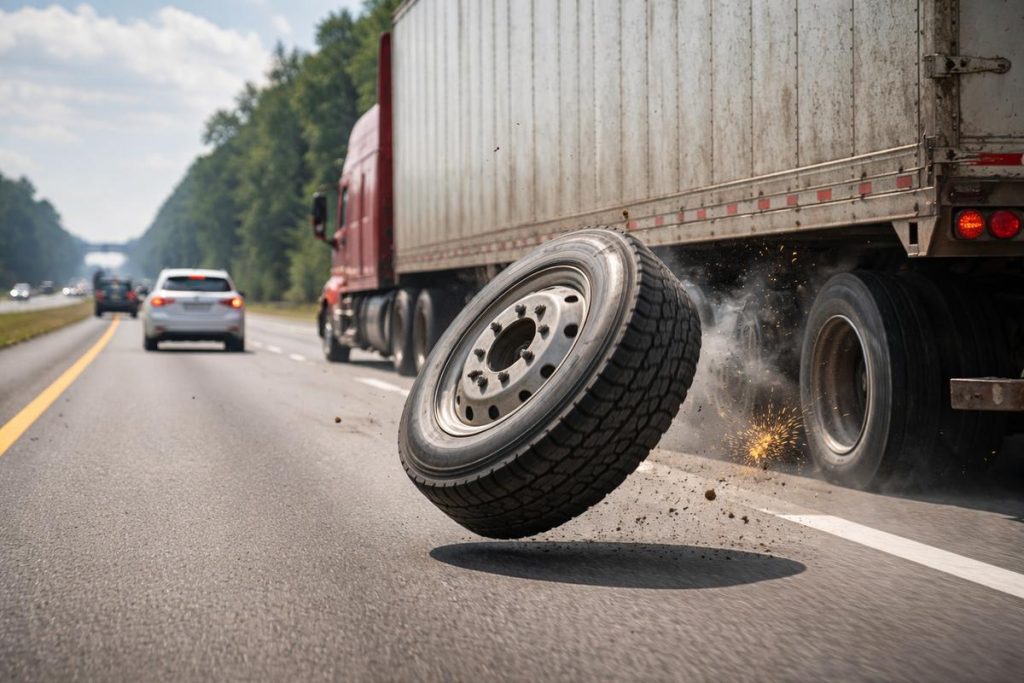
A tire-off or wheel-off truck accident happens when a tire, wheel, or related component separates from a tractor or trailer while the truck is moving.
These events may include:
- Tire-off accident: the tire detaches or a large portion of tread separates and becomes dangerous roadway debris
- Wheel-off accident: the entire wheel assembly (wheel + tire, and sometimes hub components) comes off the axle
- Dual-wheel separation: one or both dual wheels come loose from a truck or trailer axle
- Tread separation event: the tire stays mounted, but the tread peels off and strikes another vehicle
F.A.Q. What is the difference between a tire-off and a wheel-off accident?
The difference usually matters for proving fault:
- Tire-off cases often involve:
- Tire failure
- Tread separation
- Blowout from underinflation, overloading, heat, or age
- Retread failure
- Wheel-off cases often involve:
- Loose or damaged lug nuts/studs
- Improper wheel installation
- Hub, bearing, or spindle failure
- Maintenance or repair errors after wheel service
Both can overlap. For example, a wheel bearing failure may lead to a full wheel-off event that starts as heat damage in the tire/hub area.
F.A.Q. Why are tire-off and wheel-off truck accidents so dangerous?
Either type of flying debris is heavy, fast, and unpredictable.
A detached tire or wheel assembly can:
- Strike a windshield or crush a passenger compartment
- Bounce across lanes into oncoming traffic
- Cause a driver to swerve, spin out, or roll over
- Trigger chain-reaction crashes on highways
These crashes often cause severe injuries, including traumatic brain injuries, spinal injuries, fractures, and death.
F.A.Q. What causes tires to come off tractors or trailers?
Common causes of tire-off accidents include:
- Tire blowouts and tread separations
- Underinflation (a major cause of heat buildup)
- Overloading or uneven loading
- Old or weather-cracked tires
- Delamination of tire layers
- Internal belt failure
- Road hazard damage not removed from service
- Retread failures
- Poor bonding during retread process
- Defective casing
- Retread used in an improper application
- Poor inspection and maintenance
- Failure to catch visible sidewall, tread, or bead damage
- Ignoring low tire pressure warnings or signs of wear
- Reusing damaged tires
F.A.Q. What causes wheels to come off tractors or trailers?
Common causes of wheel-off accidents include:
- Improper wheel installation
- Lug nuts not torqued correctly
- \Over-torquing or under-torquing
- Cross-threaded or damaged studs
- Missing lug nuts or mismatched parts
- Failure to re-torque after service
After wheel removal or installation, many wheel systems require proper re-check/re-torque procedures. Skipping this step can lead to progressive loosening and wheel separation. - Hub, bearing, or spindle failure
- Worn bearings
- Improper lubrication
- Heat damage
- Hub failure causing the wheel end to separate
- Brake overheating
Excessive heat from downhill use or dragging brakes or can damage the wheel-end assembly and contribute to separation.
F.A.Q. Is the truck driver always responsible in a tire-off or wheel-off crash?
The driver shares fault if a pre-trip inspection should have caught signs of wheel and tire problems. But other causes include:
- Negligent maintenance
- Improper wheel service
- Defective parts
- Trailer-owner maintenance failures
That means liability may extend far beyond the driver.
Who can be liable for a tire-off or wheel-off truck accident in Georgia?
Depending on the facts, responsible parties may include:
- Truck driver (failure to inspect, ignoring warning signs)
- Motor carrier/trucking company (maintenance systems, training, dispatch pressure)
- Maintenance company or tire shop (bad installation, poor inspection, wrong parts)
- Trailer owner or leasing company (especially for leased trailers or intermodal equipment)
- Parts manufacturer or supplier (defective tire, wheel, rim, hub, studs, bearings)
- Retread company (if retread failure caused separation)
- Prior repair shop (if earlier work created the failure)
In many cases, more than one party shares fault.
Can a maintenance company or tire shop be sued in a wheel-off or tire-off case?
Yes. Maintenance vendors are common defendants in these cases.
Examples of possible negligence:
- Improper lug nut torque
- No torque documentation
- Failure to use calibrated tools
- Using incorrect studs, nuts, or wheel parts
- Failing to identify cracked rims, damaged hubs, or worn bearings
- Failing to remove unsafe tires from service
If a shop’s work contributed to the separation, it may be legally responsible.
Can the trailer owner be liable if the tractor belonged to a different company?
Yes. This issue comes up often in trucking.
A trailer may be:
- Leased
- Customer-owned
- Pool equipment
- Intermodal chassis
If the trailer owner or leasing company had maintenance duties—or provided unsafe equipment—they may be liable, especially in a wheel-off or tire-off event involving trailer axles.
What evidence is most important in a tire-off or wheel-off trucking case?
These cases are extremely fact-sensitive, depending on expert analysis of evidence. The most important proof often includes:
- The failed parts and wheel-end components
- Detached tire
- Detached wheel/rim
- Hub, bearings, studs, lug nuts
- Brake and axle-end components
- Remaining tires/wheels on the same axle (comparison evidence)
- Maintenance and inspection records
- Tire service records
- Wheel installation work orders
- Torque logs and shop procedures
- Tool calibration records
- Pre-trip and post-trip inspections
- Trailer and ownership records
- Lease agreements
- Interchange agreements
- Maintenance responsibility contracts
- Trailer/chassis identification records
- Crash scene evidence
- Photos of debris field and damage pattern
- Dashcam footage
- Witness statements
- Police report and any federal or state safety inspection notes
- Electronic evidence
- ELD and telematics data
- Dispatch messages
- Maintenance communications
Why is preserving the tire or wheel assembly so important in a tire-off or wheel-off accident in Georgia?
The physical evidence of condition and damage of a part is crucial to prove what happened.
In a tire-off case, experts may examine:
- Tread/belt separation patterns
- Heat damage
- Bead damage
- Prior puncture or repair evidence
In a wheel-off case, experts may examine:
- Lug nut/stud damage patterns
- Thread condition
- Torque-related failure signs
- Bearing and hub wear
- Fractures in wheel-end components
If the tire, wheel, or hub assembly is discarded, repaired, or lost, it becomes much harder, or impossible, to prove the cause.
F.A.Q. What insurance coverage may be available in a tire-off or wheel-off truck crash in Georgia?
There may be multiple insurance policies, not just one.
Potential coverage sources include:
- Motor carrier auto liability policy
- Carrier umbrella or excess policy
- Trailer owner/lessor liability policy
- Maintenance company liability insurance (CGL, garage liability, repairer coverage)
- Product manufacturer insurance (tire, wheel, hub, parts)
- Retread company liability policy
- Your own Uninsured / Underinsured Motorist coverage (especially if fault or vehicle identity is disputed)
Finding all available insurance is a major part of these cases.
F.A.Q. Can there be a product liability claim in a tire-off or wheel-off case in Georgia?
Yes, in some cases.
A product liability claim may apply if there is evidence of a defect in:
- Tire
- Retread
- Wheel/rim
- Hub
- Studs/lug nuts
- Bearings or related wheel-end components
These claims require preservation of the failed parts for expert inspection, so it is vitally important to secure all this physical evidence at once.
F.A.Q. What should I do after a tire-off or wheel-off truck accident in Georgia?
It is important to:
- Get medical care right away
- Take photos of the truck, trailer, debris, and roadway
- Identify the tractor and trailer numbers
- Do not give a recorded statement to the trucking insurer before legal advice
- Act quickly to preserve evidence, especially the tire/wheel assembly and maintenance records
Early action can make all the difference in these cases.
What makes tire-off and wheel-off trucking cases different from ordinary truck accidents?
These cases not just bad-driving cases. They usually involve mechanical failures, maintenance, and, sometimes, product design and manufacturing defects. Complexities involved include:
- Technical expert analysis
- Multiple defendants
- Difficulty proving the identity of the truck that lost a tire or wheel
- Missing or disputed maintenance records
- Critical physical evidence that can disappear quickly
- Multiple insurance layers
That makes early investigation especially important.
How long do I have to file a tire-off or wheel-off truck accident claim in Georgia?
Any delay can be fatal to a claim because critical evidence may be lost or discarded. It is important to evaluate deadlines and send evidence preservation notices as soon as the potential parties can be identified. In serious truck cases, waiting can also cause key evidence to disappear long before a filing deadline.
The legal time limit on claims for personal injury and wrongful death in Georgia is that they generally must be filed in court by the second anniversary of the injury or death, though there is a minefield of potential grounds for extending the time. Georgia deadlines depend on the type of claim and parties involved.
If you or someone you love has been injured in tire-off or wheel-off accident in or around Atlanta, prompt, informed legal guidance can make a substantial difference in both the outcome and the peace of mind you experience during a difficult time.
Johnson & Ward, established in 1949, was Atlanta’s first personal injury specialty law firm. Call today at (404)253-7862 to schedule a free consultation. We handle car and truck accidents, falls, and serious injury claims, and we only get paid if we win.
Ken Shigley, senior counsel, former president of the State Bar of Georgia, was the first Georgia lawyer to earn three board certifications from the National Board of Trial Advocacy: Truck Accident Law, Civil Trial Practice, and Civil Pretrial Practice. He was the lead author of eleven editions of Georgia Law of Torts: Trial Preparation and Practice, and received the Traditions of Excellence Award from the State Bar of Georgia General Practice and Trial Section. B.A., Furman University; J.D., Emory University Law School; Certificates in mediation and negotiation, Harvard Law School.
John Adkins, managing partner, experienced in personal injury law, including auto accidents, truck accidents, wrongful death, workers’ compensation, premises liability claims, dangerous or defective products, medical malpractice and related Plaintiff’s tort litigation. B.A., magna cum laude, Kennesaw State University; J.D., Thomas Jefferson Law School.
Ed Stone, partner, personal injury law, including truck accidents, auto accidents, wrongful death, workers’ compensation, premises liability claims, dangerous or defective products, medical malpractice, and related Plaintiff’s tort litigation. B.B.A., Kennesaw State University; J.D., John Marshall Law School.