

Readiness for Trial Is the Key to a Fair Settlement







Neck Injuries After an Accident in Georgia
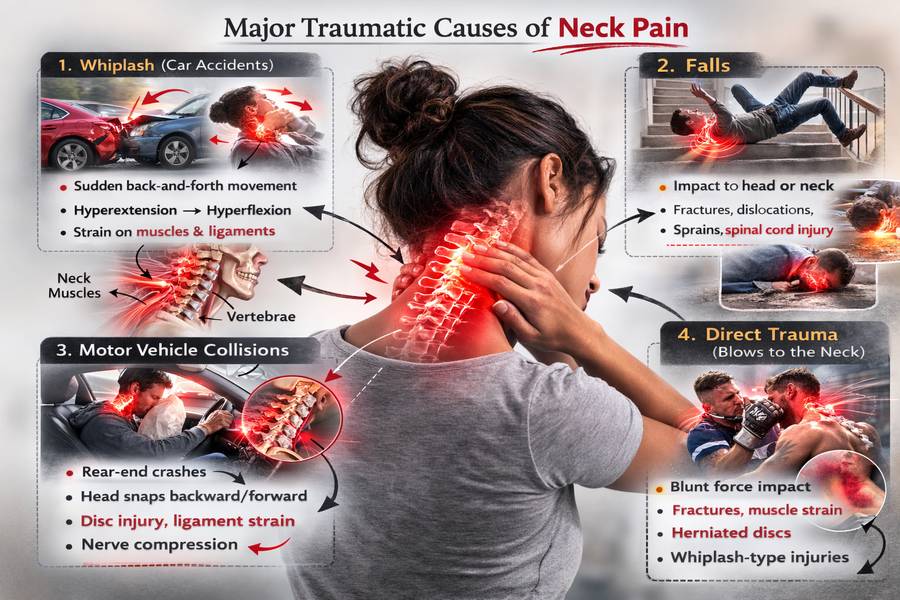
A neck injury after a crash involves trauma to the cervical spine (C1–C7), including muscles, ligaments, discs, facet joints, nerves, or vertebrae. In Georgia collisions, these injuries commonly result from rapid acceleration-deceleration forces, direct impact, or rotational torque. They range from whiplash to herniated discs, fractures, and spinal cord injury.
See also our serious personal injury information center and information on back injuries, brain injury, spinal cord injury, burn injuries, femur fractures, ankle fractures, eye injuries, ear injuries, amputations, leg amputation, facial scar injuries, scalp avulsion injuries, hand fracture injuries, myofascial pain injuries, foot drop, TMJ (tempormandibular joint) injuries, asbestos and silica lung illness, and syringomyelia.
In rear-end crashes on I-285 or Peachtree Street, the mechanism is typically hyperextension followed by hyperflexion—what most people call “whiplash.” In higher-speed collisions or truck crashes the forces can produce disc disruption, annular tears, or instability at C5-C6 and C6-C7.
In our experience trying catastrophic injury cases across Georgia, defense experts often minimize early complaints as “soft tissue.” That label misses the medical reality. Soft tissue structures—discs, ligaments, nerve roots—are precisely what generate chronic pain and impairment in the neck and radiating into the shoulders and arms when damaged.
F.A.Q. What are the most common types of neck injuries in Georgia accident cases?
The most frequent cervical injuries in Georgia crash claims are whiplash (strain/sprain), herniated or bulging discs, cervical radiculopathy, facet joint injuries, fractures, and spinal cord trauma. Severity ranges from temporary inflammation to permanent neurologic impairment requiring surgery.
1) Whiplash (Cervical Strain/Sprain)
Rapid back-and-forth motion stretches muscles and ligaments beyond tolerance. Symptoms often intensify over 24–72 hours.
Typical features:
- Neck stiffness and reduced range of motion
- Headaches at the base of the skull
- Shoulder blade pain
- Dizziness or concentration difficulty
Georgia juries understand delayed pain. I have seen multiple cases where clients declined ambulance transport, only to develop severe spasm and headaches the next day.
2) Herniated or Bulging Cervical Disc
Trauma can cause disc protrusion or extrusion, irritating adjacent nerve roots. Magnetic Resonance Imaging (MRI) frequently identifies pathology at C5-C6 or C6-C7.
When a disc compresses a nerve root, symptoms are not vague—they follow dermatomal patterns. That objective correlation between imaging and neurologic exam strengthens causation.
3) Cervical Radiculopathy (“Pinched Nerve”)
Radiating arm pain, numbness, tingling, or weakness signals nerve compression. EMG testing may confirm ongoing denervation when symptoms persist.
4) Cervical Facet Joint Injury
Facet joints can be injured by rotational forces, particularly in side-impact (T-bone) crashes common at Atlanta intersections. Diagnosis is clinical; medial branch blocks sometimes confirm pain generators.
5) Cervical Fracture or Dislocation
High-speed collisions or significant falls can produce vertebral fractures. CT scanning provides detailed fracture assessment. Instability may require surgical fixation.
6) Spinal Cord Injury (SCI)
Cord involvement is a medical emergency. Weakness, paralysis, or loss of bowel/bladder control demands immediate intervention. These cases often involve substantial primary and excess insurance layers.
F.A.Q. What neck injury symptoms require immediate emergency care?
Weakness, progressive numbness, balance problems, loss of coordination, bowel or bladder dysfunction, severe headache with neck pain, confusion, or repeated vomiting require urgent evaluation. Midline cervical tenderness after significant impact also warrants ER assessment and imaging.
Hospitals in metro Atlanta routinely follow trauma protocols. CT scans rule out fracture; MRI evaluates cord compressation. Delay in diagnosis can worsen neurologic outcomes and complicate legal causation arguments.
F.A.Q. How are neck injuries diagnosed and documented for a Georgia injury claim?
Diagnosis begins with clinical history and physical examination, followed by imaging when indicated. X-rays identify fractures or alignment issues. CT scans define complex trauma. MRI evaluates discs, nerves, and soft tissues. Thorough documentation directly affects claim value.
From a litigation standpoint, three elements matter:
- Temporal proximity – Prompt medical evaluation ties symptoms to the collision.
- Objective findings – MRI evidence of disc herniation or documented neurologic deficits carry weight.
- Consistency – Physical therapy records showing functional limitation and progression reinforce credibility.
In trial, defense counsel often highlights degenerative changes. The key question under Georgia law is aggravation. If a crash worsens a pre-existing condition, the at-fault party is responsible for that aggravation.
F.A.Q. What treatment options exist for serious cervical spine injuries?
Most neck injuries begin with conservative care: anti-inflammatory medication, structured physical therapy, posture correction, and home exercise. Persistent cases may require injections or surgery. Treatment depends on neurologic findings and response over time.
Conservative Management
- Supervised physical therapy
- Targeted strengthening and stabilization
- Activity modification
Interventional Procedures
- Epidural steroid injections
- Medial branch blocks
- Radiofrequency ablation for facet-mediated pain
Surgical Intervention
- Anterior cervical discectomy and fusion (ACDF)
- Disc replacement in selected cases
- Stabilization for unstable fractures
Future medical cost projections—particularly where surgery is probable—must be supported by treating physicians or life-care planners.
F.A.Q. How does Georgia law determine liability for a neck injury accident?
Georgia follows a fault-based system with modified comparative negligence. Under O.C.G.A. § 51-12-33, a plaintiff who is 50% or more responsible cannot recover damages. If less than 50% at fault, recovery is reduced proportionally.
Liability analysis may extend beyond the at-fault driver:
- Employer liability under respondeat superior
- Negligent entrustment
- Trucking company violations of FMCSA safety regulations
- Maintenance contractors
- Product manufacturers (defective seatbacks or airbags)
- Government entities, subject to sovereign immunity limits and ante litem notice requirements
When a commercial vehicle is involved, insurance layering becomes critical. There may be:
- Primary auto liability coverage
- Excess or umbrella policies
- Motor carrier policies
- Broker liability coverage
Sophisticated catastrophic injury cases often involve stacking and priority disputes among carriers.
F.A.Q. What compensation is available in a Georgia neck injury claim?
A successful claim may include medical expenses, future medical care, lost income, diminished earning capacity, pain and suffering, and permanent impairment. Severe cases may involve substantial damages reflecting long-term disability.
Documentation drives valuation:
- MRI and specialist records
- Work restrictions and wage verification
- Functional capacity evaluations
- Expert testimony on future care
In cases involving spinal cord injury or multi-level fusion, exposure often reaches into excess layers. Early case preparation signals seriousness to insurers evaluating reserves.
F.A.Q. How long do neck injuries last after a crash?
Mild strains may resolve within weeks. Disc injuries and radiculopathy can persist for months. Fractures and spinal cord injuries may result in permanent impairment. Delayed symptom escalation within 72 hours is common and medically recognized.
I have seen juries respond thoughtfully when the medical timeline is explained clearly. Adrenaline masks pain. Inflammation peaks later. That progression is consistent with cervical trauma physiology.
F.A.Q. What strengthens a Georgia neck injury case?
- Immediate medical evaluation
- Consistent follow-up care
- Objective imaging findings
- Clear neurologic documentation
- Photographs of vehicle damage
- Police crash reports
- Employer wage documentation
Insurance carriers frequently argue minimal vehicle damage equals minimal injury. That argument collapses under biomechanical testimony when necessary.
Call today at (404)253-7862 to schedule a free consultation. We handle car and truck accidents, falls, and serious injury claims, and we only get paid if we win.
Ken Shigley, senior counsel, former president of State Bar of Georgia, triple board certified by National Board of Trial Advocacy, lead author of eleven editions of Georgia Law of Torts: Trial Preparation and Practice, and received the Traditions of Excellence Award from the State Bar of Georgia General Practice and Trial Section. B.A., Furman University; J.D., Emory University Law School; Certificates in mediation and negotiation, Harvard Law School. “Best Lawyers in America” (2024); Tradition of Excellence Award for Lifetime Achievement (2019); Board of Regents, Academy of Truck Accident Attorneys (2015-21); Diplomate, National College of Advocacy (2017); National Board of Trial Advocacy, Board Certification in Truck Accident Law (2019); National Board of Trial Advocacy, Board Certification in Civil Pretrial Advocacy (2012); National Board of Trial Advocacy, Board Certification in Civil Trial Advocacy (1995); Chair, American Association for Justice (AAJ) Motor Vehicle Collision, Highway & Premises Liability Section (2015-16)( included over 2,500 trial lawyers in all 50 states and specialized litigation groups on Trucking Litigation, Bus Litigation, Traumatic Brain Injury, Spinal Cord Injury, Motorcycle Litigation, Bicycle Litigation, Resort Torts Litigation and Inadequate Security Litigation); Criminal Justice Reform Council, appointed by Governor Nathan Deal (2011-13); Commission on Continuing Lawyer Competency (2012-13); Chief Justice’s Commission on Professionalism (2011-12); Georgia Commission on Dispute Resolution (2011-12); Georgia Courts Automation Commission (2008-10); Judicial Council of Georgia Standing Committee on Technology(2015-20); National Conference of Bar Presidents (2010-13); Southern Conference of Bar Presidents (2010-13); Chair, State Bar of Georgia Insurance Law Section (1994-95); Chair, Georgia Insurance Law Institute (1994); Peer ratings: “AV” in Martindale-Hubbell, Bar Register of Preeminent Lawyers (since 1995), “Super Lawyers,” “Legal Elite” (Georgia Trend), Avvo 10.0, “Who’s Who in Law” listing in Atlanta Business Chronicle; Chapter author – Handling Motor Vehicle Accident Cases (Thompson Reuters West)
John Adkins, managing partner, experienced in personal injury law, including auto accidents, truck accidents, wrongful death, workers’ compensation, premises liability claims, dangerous or defective products, medical malpractice and related Plaintiff’s tort litigation. B.A., magna cum laude, Kennesaw State University; J.D., Thomas Jefferson Law School.
Ed Stone, partner, personal injury law, including truck accidents, auto accidents, wrongful death, workers’ compensation, premises liability claims, dangerous or defective products, medical malpractice, and related Plaintiff’s tort litigation. B.B.A., Kennesaw State University; J.D., John Marshall Law School.