
Readiness for Trial Is the Key to a Fair Settlement


Multi-Vehicle Truck Accidents in Georgia: Liability in Atlanta Chain-Reaction Crashes
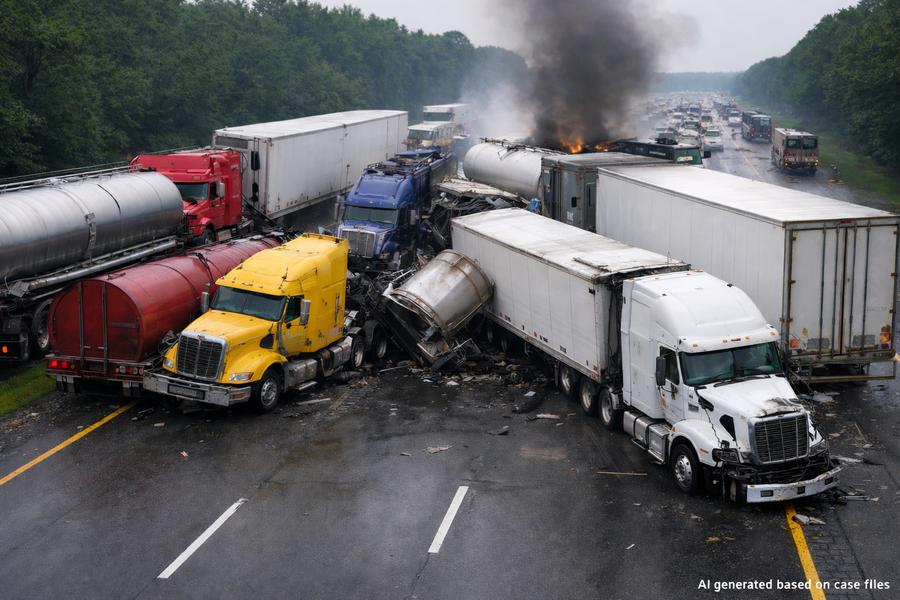
A multi-vehicle truck crash in Georgia is often a high-stakes evidence case. In metro Atlanta, these collisions commonly happen on high-volume corridors like I-285, I-75, I-85, I-20, I-16, and I-95 or other roadways where slowdowns and lane changes can trigger chain-reaction impacts in seconds.
See also truck accident information center and information on concrete mixer truck accidents, dump truck accidents, log truck accidents, tire and wheel off truck accidents, truck accidents in bad weather, and reasons to file a truck accident case in Georgia.
When a tractor-trailer is involved, the case is usually more complex than a typical car wreck because there may be:
- multiple injured drivers and passengers,
- multiple insurance carriers,
- commercial vehicle data (ELD/ECM/camera evidence),
- road construction activity at the scene,
- and disputes about which impact caused which injury.
If you were hurt in a truck-involved pileup in Atlanta or anywhere in Georgia, this page explains what matters most and how these claims are typically investigated.
F.A.Q. What is a multi-vehicle truck crash?
A multi-vehicle truck crash (often called a chain-reaction collision or pileup) usually involves 3 or more vehicles, with a commercial truck contributing to the sequence.
Common Georgia examples include:
- A tractor-trailer rear-ends stopped traffic and pushes vehicles forward
- A truck changes lanes in congested Atlanta traffic and triggers evasive collisions
- A jackknife blocks lanes and causes secondary impacts
- Heavy rain, fog, or low visibility causes a chain reaction on interstates
In many cases, the worst injuries happen in secondary impacts, not the first hit.
F.A.Q. Why are multi-vehicle truck cases are in Georgia harder than car wrecks?
These claims are more difficult than ordinary car wreck cases because:
- The sequence of impacts must be proven
- In a pileup, insurers often argue over who hit whom first.
- There are more parties
- Truck drivers, motor carriers, highway construction contractor, maintenance contractor, broker, shipper, and other drivers may all be involved.
- Commercial evidence matters
- Trucking records, video, dispatch communications, and electronic data can make or break the case.
- Insurers move fast
- Commercial carriers often begin investigating immediately.
F.A.Q. Common causes of Atlanta and Georgia truck pileups
In Georgia truck-involved multi-vehicle crashes, common causes include:
- Following too closely
- Driving too fast for conditions
- Distracted driving
- Fatigue / hours-of-service issues
- Unsafe lane changes in dense traffic
- Brake or tire failures
- Cargo shifting or load problems
- Jackknife events
- Traffic slowing and merging in congested areas
- Work-zone congestion and sudden stops
Metro Atlanta traffic patterns can worsen these risks, especially at interstate merges, lane drops, and stop-and-go congestion, which reduce reaction time.
F.A.Q. Who may be liable in a Georgia multi-vehicle truck accident?
In Georgia, liability may be shared across multiple parties. Depending on the facts, responsible parties may include:
- The truck driver
- The trucking company (motor carrier)
- A maintenance or repair company
- A shipper / loader
- A freight broker (in some cases)
- One or more other drivers
- A government entity or contractor (road construction/work-zone issues, where applicable)
F.A.Q. Georgia venue and local court considerations
Where a lawsuit is filed depends on Georgia venue rules and the facts of the case (including where defendants reside and how claims are pleaded). Georgia law specifically addresses situations involving codefendants/joint tortfeasors in different counties. Years ago, the conventional wisdom was that substantial verdicts could be obtained only in a couple of metro counties. That is no longer accurate. Knowledge of the counties and the judges in each court is helpful.
Georgia note: Claims involving state or local government entities can raise additional notice and immunity issues, so those cases require especially early case analysis.
F.A.Q. What is the evidence that matters most in a Georgia truck pileup case?
Multi-vehicle truck cases are won with timing, reconstruction, and preservation. Key evidence often includes:
- Truck ECM / event data (speed, braking, throttle)
- ELD records (hours-of-service/fatigue clues)
- Dashcam or onboard video
- Driver qualification and training records
- Dispatch texts / communications
- Inspection and maintenance records
- Cargo and load documentation
- Police crash reports and diagrams
- 911 recordings
- Photos of vehicle rest positions and debris fields
- Witness statements from multiple drivers/passengers
Because there are more vehicles and more insurers in a pileup, evidence can disappear fast. Early preservation is especially important.
F.A.Q. How is is analyzed in a chain-reaction crash?
In a Georgia multi-vehicle truck case, the key question is usually, “Who created the first dangerous condition, and how did the impacts unfold?” That requires reconstruction of:
- impact order,
- vehicle positions,
- speeds,
- braking,
- visibility,
- and whether drivers had a realistic chance to avoid the crash.
In many pileups, more than one party contributed to the collision sequence. That does not necessarily prevent a valid injury claim.
F.A.Q. What serious injuries are common in truck-involved pileups?
Because chain-reaction crashes often involve multiple impacts, these cases frequently include:
- traumatic brain injury (TBI)
- spinal cord injuries
- back injuries
- fractures
- shoulder injuries
- internal injuries
- PTSD / trauma symptoms
- wrongful death
F.A.Q. What should I do after a truck-involved multi-vehicle crash in Georgia?
If you are physically able:
- Get medical care right away
- Photograph vehicles, DOT numbers, lane positions, and road conditions
- Get witness contact information
- Preserve your own dashcam/phone data
- Avoid giving recorded statements to trucking insurers before getting advice
- Write down what happened while it’s fresh
In Atlanta-area pileups, scenes clear quickly. Tow operators, police, and insurers may move vehicles before you realize how important those details are.
F.A.Q. Can I still recover if several drivers were involved?
Often yes. Multi-vehicle crashes commonly involve shared fault. The legal issue is usually how the chain reaction started and which parties contributed to your injuries.
F.A.Q. What if the police report does not fully explain the sequence?
That is common in pileup cases. Police often write up each collision separately rather than combining it all on one report. Police reports are important, but truck data, video, and reconstruction evidence often provide a clearer picture.
F.A.Q. Why is trucking evidence different from ordinary car crash evidence?
Commercial trucks generate and store additional evidence (ELD, ECM, company records, dispatch communications) that usually does not exist in a standard passenger-car crash.
F.A.Q. Do Atlanta-area truck pileup cases usually involve multiple insurance companies?
Yes. In many cases there are several insurers involved, including the truck carrier’s insurer and insurers for other vehicles in the collision sequence. We have seen cases with up to 20 insurance companies involved.
Johnson & Ward, established in 1949, was Atlanta’s first personal injury specialty law firm. Call today at (404)253-7862 to schedule a free consultation. We handle car and truck accidents, falls, and serious injury claims, and we only get paid if we win.
Ken Shigley, senior counsel, former president of the State Bar of Georgia, was the first Georgia lawyer to earn three board certifications from the National Board of Trial Advocacy: Truck Accident Law, Civil Trial Practice, and Civil Pretrial Practice. He was the lead author of eleven editions of Georgia Law of Torts: Trial Preparation and Practice, and received the Traditions of Excellence Award from the State Bar of Georgia General Practice and Trial Section. B.A., Furman University; J.D., Emory University Law School; Certificates in mediation and negotiation, Harvard Law School.
John Adkins, managing partner, experienced in personal injury law, including auto accidents, truck accidents, wrongful death, workers’ compensation, premises liability claims, dangerous or defective products, medical malpractice, and related Plaintiff’s tort litigation. B.A., magna cum laude, Kennesaw State University; J.D., Thomas Jefferson Law School.
Ed Stone, partner, personal injury law, including truck accidents, auto accidents, wrongful death, workers’ compensation, premises liability claims, dangerous or defective products, medical malpractice, and related Plaintiff’s tort litigation. B.B.A., Kennesaw State University; J.D., John Marshall Law School.