
Readiness for Trial Is the Key to a Fair Settlement










Low and Mid Back Fracture Injuries
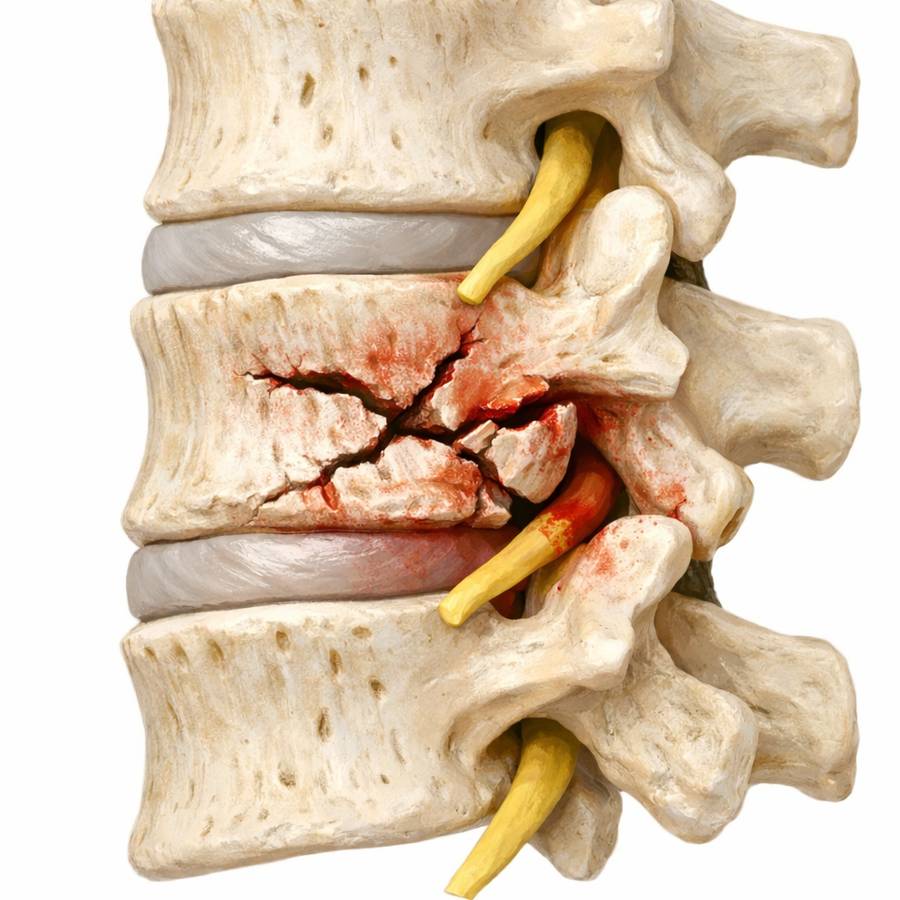
Low and mid back fractures are among the most serious spine injuries we see after high‑energy car and truck crashes, often causing excruciating pain, long‑term disability, and a lifetime of medical care. When a lumbar vertebra or thoracic vertebra breaks—especially in a burst or rotational fracture—bone fragments can damage the spinal cord or nerves, leading to weakness, numbness, or even paralysis and loss of bowel or bladder control.
This page explains the main types of low back and mid back fractures, how they occur, how doctors diagnose and treat them, and what permanent impairments may follow. It draws on Johnson & Ward’s experience representing Georgians with catastrophic low and mid back injuries after rear‑end impacts, head‑on collisions, and other violent impacts.
See also our information center on other serious injuries, neck injuries, back injuries, brain injury, spinal cord injury, burn injuries, femur fractures, ankle fractures, eye injuries, ear injuries, amputations, leg amputation, facial scar injuries, scalp avulsion injuries, hand fracture injuries, myofascial pain injuries, foot drop, TMJ (tempormandibular joint) injuries, asbestos and silica lung illness, and syringomyelia.
How do low back fractures happen?
Truck and car crashes are common causes of lumbar fractures, especially when a smaller vehicle is struck at high speed or crushed between larger vehicles. We often see compression and burst fracture injuries in clients hit hard from the rear by tractor‑trailers—collisions involving large amounts of kinetic energy that the spine must suddenly absorb. Low back fractures can also result from falls from height, rollovers, and other major trauma.
Types of low and mid back vertebral fractures.
Low and mid back injuries can appear in many forms, including vertebral fractures, ruptured or bulging discs, and damage to nerves, ligaments, tendons, and muscles. A single incident can injure several of these structures at once.
What are lumbar and thoracic compression fractures?
Compression fractures are small breaks that cause a vertebra to lose height, often collapsing in the front and forming a wedge shape. If bone density is already reduced by osteoporosis, a trauma such as a rear‑end collision can turn a silent vulnerability into a painful, debilitating fracture.
Compression fractures can lead to:
- Chronic back pain.
- Progressive spinal curvature and disfigurement.
- Impaired ability to perform daily activities.
- Loss of height.
- Increased risk of pressure sores and associated complications.
Post‑menopausal women with osteoporosis are particularly vulnerable, and smokers face somewhat higher risk than non‑smokers.
What are burst fracture injuries?
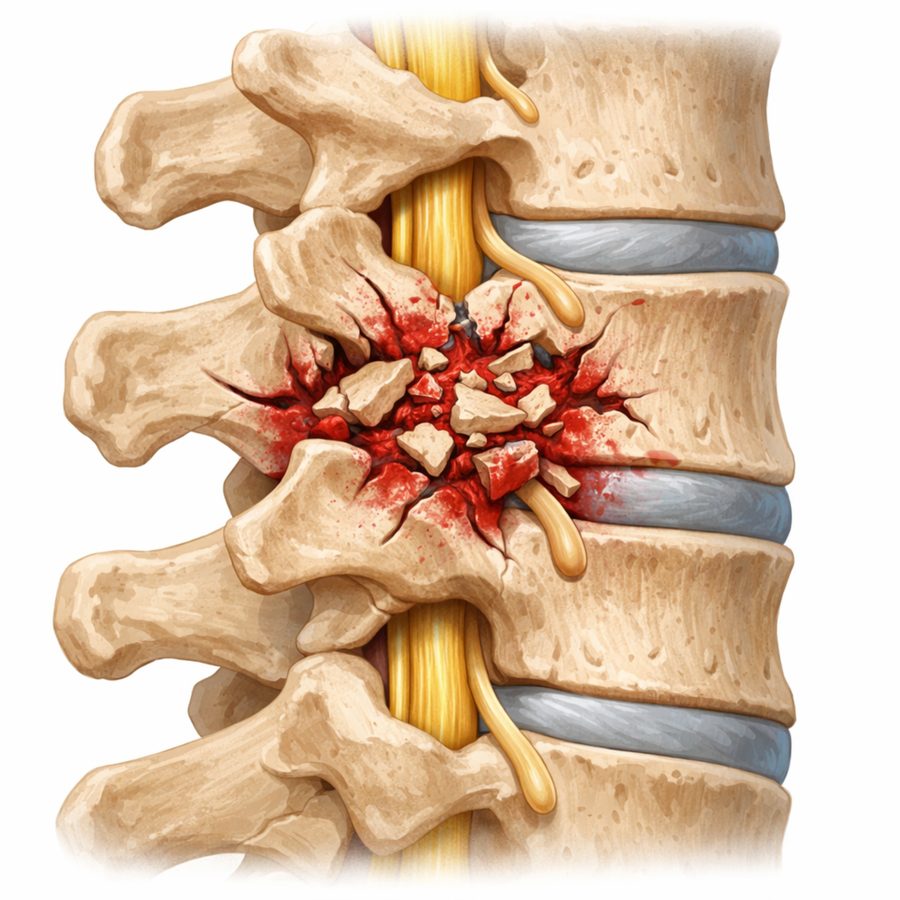
Burst fractures are more severe than simple compression fractures. In a burst fracture, the vertebral body shatters from extreme vertical pressure to high energy accidents, often causing bone fragments to spread outward penetrating surrounding tissue or inward into the spinal canal. Because the entire margin of the vertebral body is compromised, the spine becomes much less stable than in a wedge‑type compression fracture.
Consequences may include:
- Spinal cord bruising or compression.
- Neurologic deficits, including weakness, numbness, or paralysis.
- Long‑term pain and functional loss.
Immediate hospitalization is required in cases of suspected burst fracture due to the risk of spinal cord damage and paralysis. Diagnosis typically involves X‑rays, CT scans, and MRI to assess both bone and nerve structures.
Treatment often includes:
- Stabilize the fractured vertebra with “bone glue” products, especially in older patients and those whose injuries make the use of plates and screws unreliable.
- Spinal fusion and stabilization with rods, screws, plates, or cages in younger or otherwise suitable patients.
- Custom‑fitted full‑body bracing worn around the clock for months in non‑surgical cases.
- Physical therapy to rebuild muscle strength and restore function once the spine is stabilized.
In older patients with fragile bones, it may be difficult to secure plates and screws. In those cases, doctors sometimes perform vertebroplasty, injecting bone cement into the damaged vertebra to help stabilize and support the spine.
Burst fracture injuries are intensely painful, and pain management can be a long‑term challenge with its own risks, including drug dependency or addiction.
What are seat belt “Chance” fractures
A Chance fracture—named for Dr. Chance, who first described the injury—is an unstable fracture usually occurring at the thoracolumbar junction (T10–L2). This pattern accounts for a large proportion of spinal injuries outside the cervical spine.
Chance fractures were more common before shoulder harnesses became standard. In a head‑on collision where the pelvis is restrained only by a lap belt, the upper body can pitch forward over the belt, which acts as a fulcrum and forces the spine into extreme flexion. This can result in a horizontal fracture extending from the posterior elements through the vertebral body.
About half of Chance fractures are associated with internal organ injuries, such as ruptures of the spleen, bowel, or bladder. Because there may be no obvious neurologic symptoms at first, emergency physicians can easily overlook these injuries, and delayed diagnosis can significantly worsen outcomes.
Treatment typically includes:
- Stabilization with a brace or cast in less severe cases.
- Surgical fixation when there is instability or neurologic involvement.
What is a rotational low back fracture injury?
Rotation fracture‑dislocations involve both bone and surrounding ligaments and other soft tissues. These injuries can cause severe spinal instability and spinal cord compression. Treatment usually requires surgery to realign and stabilize the spine, often with combination hardware.
What are common permanent impairments after low back fracture injuries?
Low back fractures often leave some degree of permanent impairment even after the best available treatment. The American Medical Association Guides to the Ehttps://www.ama-assn.org/practice-management/ama-guides/ama-guides-evaluation-permanent-impairment-overviewvaluation of Permanent Impairment provides a framework for assigning physical impairment ratings to various spinal injuries.
It is important to understand that:
- A physical impairment rating is not the same as occupational disability.
- Someone with a seemingly modest impairment rating may be completely unable to continue a physically demanding job.
- Another person with a similar rating may be able to perform sedentary office work.
For that reason, we often consider evaluation by a vocational rehabilitation expert to assess the real‑world impact of the injury on work capacity and earning potential.
What are common legal considerations in low back fracture cases?
Low back fracture cases require careful documentation of:
- The mechanism of injury (often high‑energy Atlanta auto accidents or Atlanta truck accidents).
- Radiologic findings and surgical reports.
- Pain management history and any complications.
- Functional limitations and restrictions from treating doctors.
- Vocational assessments regarding work capacity.
Because these injuries may require lifelong care and substantially alter a person’s earning ability and quality of life, a settlement or verdict must account for both current and future damages.
When should I talk to an Atlanta injury lawyer?
If you or a loved one has suffered a low back fracture in a crash or other traumatic event, you do not have to navigate complex medical and legal issues alone. Since 1949, Johnson & Ward has had decades of experience handling serious spinal injury cases, working with leading surgeons, rehabilitation specialists, and vocational experts to present the full impact of these injuries.
Call us at 404‑253‑7862 for a free consultation. We handle serious back and spinal injury claims arising from car and truck crashes and other acts of negligence throughout Georgia, and we only charge a fee if we recover compensation for you.
Johnson & Ward, founded in 1949, was Atlanta’s first personal injury specialty practice. Our lawyers represent people injured in automobile accidents, truck crashes, slip-and-fall incidents, and other serious injury claims, and we do not charge a fee unless we recover compensation.
Senior counsel Ken Shigley is a former State Bar of Georgia president and holds three board certifications from the National Board of Trial Advocacy. He also served as lead author of Georgia Law of Torts: Trial Preparation and Practice.
Managing partner John Adkins focuses on auto and truck accident cases, wrongful death litigation, workers’ compensation claims, premises liability cases, product liability litigation, and medical malpractice claims.
Partner Ed Stone practices personal injury law with emphasis on trucking accidents, car collisions, wrongful death cases, workers’ compensation disputes, premises liability claims, and defective product cases.