
Readiness for Trial Is the Key to a Fair Settlement


Chiari Malformation and Syringomyelia After Georgia Car or Truck Accidents
Most people never hear of syringomyelia or Chiari malformations until they are diagnosed after an extremely painful injury.
What Is Post-Traumatic Syringomyelia?
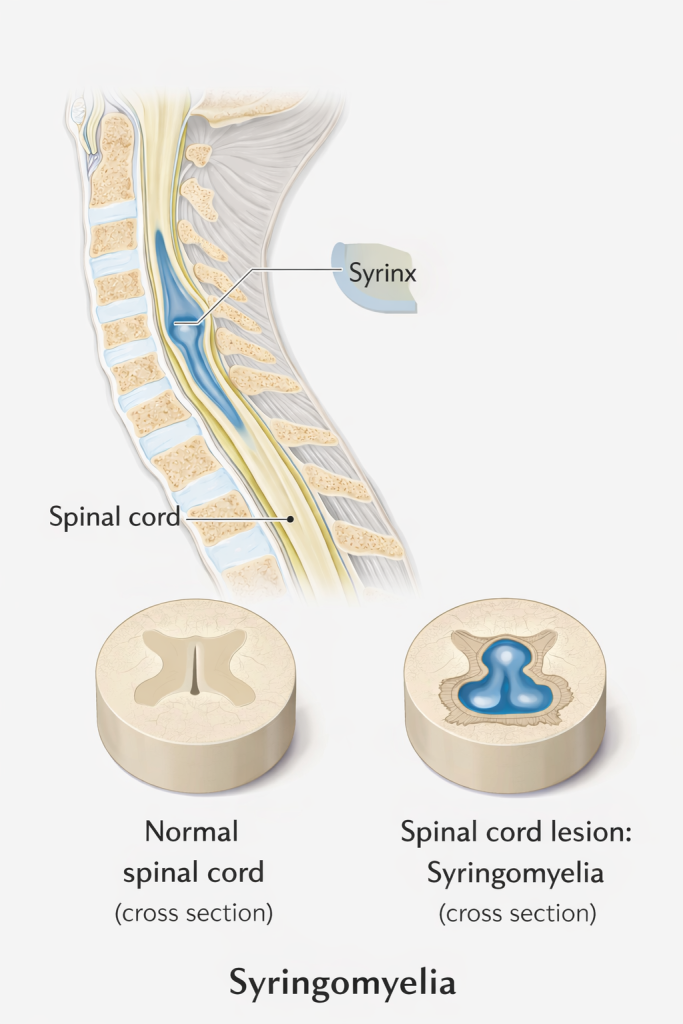
Post-traumatic syringomyelia develops when a fluid-filled cavity, called a syrinx, forms inside the spinal cord after trauma. The cavity may appear months or years after a crash. As it expands, it damages nerve tissue and causes progressive weakness, pain, and loss of sensation in the shoulders and arms, chronic pain, weakness and stiffness.
A syrinx is not visible on plain X-rays. MRI imaging confirms the diagnosis.
Symptoms often include:
- Burning nerve pain
- Muscle wasting
- Loss of temperature sensation
- Progressive limb weakness
Syringomyelia frequently involves delayed onset. Insurance carriers exploit that delay. They argue the condition is unrelated because symptoms appeared later.
In litigation, proof requires:
- A documented traumatic event
- A clear medical timeline
- Sequential MRI findings
- Credible neurosurgical testimony
When the records show a stable patient before impact and measurable deterioration afterward, the argument becomes much stronger.
See also our serious injury information center, and details on neck injuries, back injuries, brain injury, spinal cord injury, femur fractures, ankle fractures, eye injuries, ear injuries, amputations, leg amputation, facial scar injuries, scalp avulsion injuries, hand fracture injuries, myofascial pain injuries, foot drop, TMJ (tempormandibular joint) injuries, asbestos and silica lung illness, and wrongful death.
Can an accident cause or trigger symptoms of Chiari Malformation?
A Georgia car or truck collision can trigger or significantly worsen symptoms of Chiari malformation. Trauma may force the lower part of the brain downward, increasing pressure at the base of the skull. Even if a condition existed quietly before the crash, Georgia law allows recovery when negligence aggravates a preexisting condition.
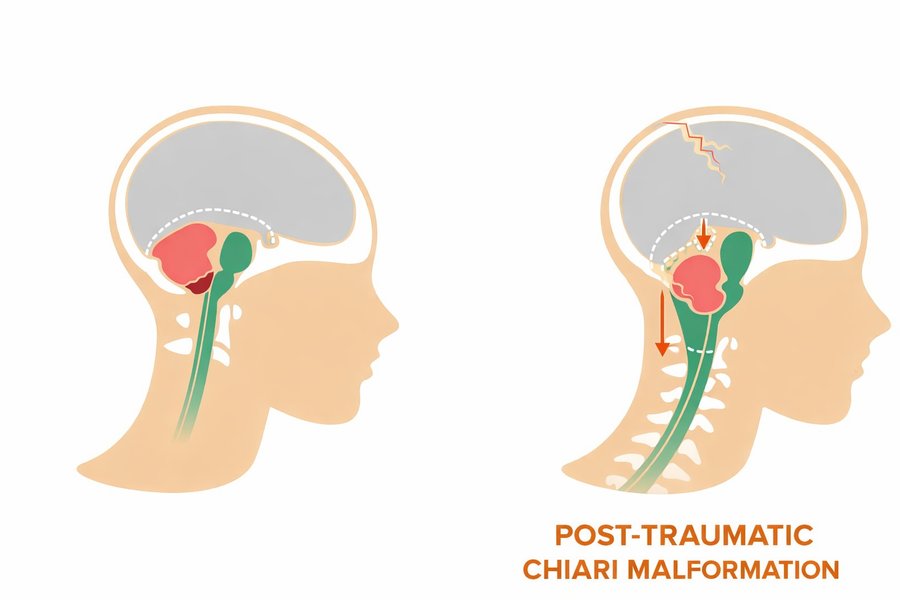
A Chiari malformation occurs when part of the cerebellum extends into the opening at the base of the skull, called the foramen magnum. That tight space surrounds the brainstem and upper spinal cord.
A sudden rear-end collision can produce rapid flexion-extension forces. That motion can increase tonsillar descent — sometimes called cerebellar tonsillar herniation. When that happens, patients may develop:
- Severe occipital headaches
- Neck pain
- Vertigo
- Arm weakness
- Numbness or tingling
Standard X-rays and CT scans usually miss this. An MRI provides the clearest imaging evidence.
The defense usually argues the condition was congenital and unrelated to the wreck. Georgia law does not require the crash to create the condition. It only requires proof that negligence made it worse. With careful preparation of medical proof, the aggravation of a previously asymptomatic preexisting condition may have as much or more value as a brand new injury.
How Do You Prove That a Crash Aggravated a Preexisting Condition in Georgia?
Georgia law permits recovery when a crash aggravates a preexisting medical condition. The injured person does not need to prove the wreck caused the condition from birth. The key question is whether negligence made the condition worse and increased symptoms, disability, or need for surgery.
Georgia follows the “aggravation of preexisting condition” rule. A negligent driver takes the injured person as they find them.
In practice, that means:
- Compare pre-crash and post-crash medical records
- Establish functional decline
- Demonstrate new imaging changes
- Present expert testimony linking trauma to worsening
Defense experts often focus on congenital origin. Jurors focus on change. Proof of before and after activities and abilities are important. The timeline wins cases.
What Insurance Coverage Issues Arise in Serious Chiari and Syringomyelia Cases?
Severe brain and spinal cord injury claims often involve layered insurance coverage. In Georgia truck crash cases, recovery may include primary liability coverage, excess policies, umbrella policies, broker liability coverage, and maintenance contractor insurance. Identifying every policy early can determine whether full compensation is possible.
In commercial trucking collisions, coverage may involve:
- A primary auto liability policy
- One or more excess policies
- Umbrella coverage
- Freight broker liability
- Trailer owner coverage
- Maintenance contractor negligence
- Employer liability
If a government vehicle is involved, sovereign immunity limits may apply under Georgia law. Those deadlines are short and unforgiving.
In catastrophic injury cases, failure to identify layered coverage early can permanently limit recovery.
When Is Surgery Necessary for Syringomyelia or Chiari Malformation?
Neurosurgeons may recommend decompression surgery when brainstem compression or spinal cord damage causes progressive neurological decline. The procedure removes bone at the base of the skull to create more space and reduce pressure. Surgery carries risk and often becomes a major component of damages in litigation.
Surgical recommendations strengthen causation arguments when imaging correlates with symptoms. Defense experts often challenge timing. Clear documentation matters.
Johnson & Ward was founded in 1949 as Atlanta’s first and best personal injury specialty law firm. Call today at (404)253-7862 to schedule a free consultation. We handle car and truck accidents, falls, and serious injury claims, and we only get paid if we win.
Ken Shigley, senior counsel, former president of the State Bar of Georgia, was the first Georgia lawyer to earn three board certifications from the National Board of Trial Advocacy: Truck Accident Law, Civil Trial Practice, and Civil Pretrial Practice. He was the lead author of eleven editions of Georgia Law of Torts: Trial Preparation and Practice, and received the Traditions of Excellence Award from the State Bar of Georgia General Practice and Trial Section. B.A., Furman University; J.D., Emory University Law School; Certificates in mediation and negotiation, Harvard Law School.
John Adkins, managing partner of Johnson & Ward, is experienced in wrongful death, personal injury law, including auto accidents, truck accidents, workers’ compensation, premises liability claims, dangerous or defective products, medical malpractice, and related Plaintiff’s tort litigation. B.A., magna cum laude, Kennesaw State University; J.D., Thomas Jefferson Law School.
Ed Stone, is a partner focusing on personal injury law, including wrongful death, truck accidents, auto accidents, workers’ compensation, premises liability claims, dangerous or defective products, medical malpractice, and related Plaintiff’s tort litigation. B.B.A., Kennesaw State University; J.D., John Marshall Law School.