

Readiness for Trial Is the Key to a Fair Settlement









Asbestos and Silica Lawsuits in Georgia: What Families Need To Know
What is asbestos and why was it used so widely?
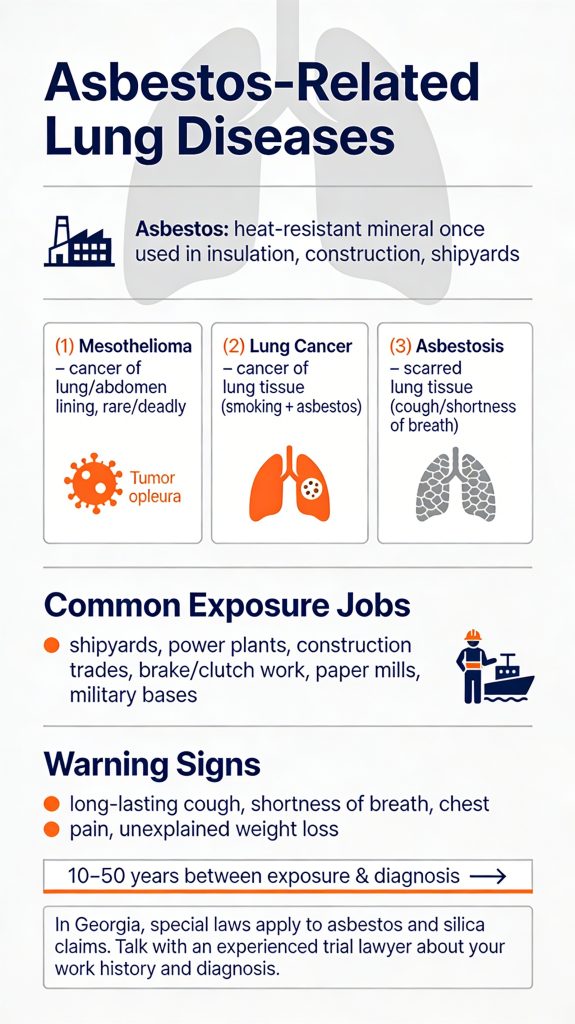
Asbestos is a natural mineral that resists heat, fire, and chemicals, so companies used it for decades in insulation, building materials, and shipyards. It was common in homes, schools, factories, and military sites. Only later did families learn it could cause deadly lung diseases many years after exposure.
While large companies in the asbestos business may have been long aware of the risks accompanying asbestos, most users did not. In the 1950s, my dad was principal of a rural school that had replaced an earlier school building that burned down in the 1940s. I recall him bragging about the modern fireproofing: asbestos. He had no clue that it could cause serious injury. A few years ago it was time for major renovation but the building was so filled with asbestos that it was more economical to replace it with a new school building.
Asbestos fibers are thin and sharp. When materials are cut, drilled, or torn out, those fibers can float in the air and reach deep into the lungs. Over time, this can cause asbestosis (lung scarring), lung cancer, and mesothelioma, a rare cancer of the lining of the lung or abdomen. These diseases often appear 20 to 50 years after exposure, which is why a worker from the 1960s may not be diagnosed until retirement age.
Use of asbestos exploded in the late 1800s and early 1900s. It was placed in pipe insulation, boiler rooms, ceiling tiles, joint compound, fireproofing spray, brake linings, and more. In the 1970s, U.S. asbestos use peaked at hundreds of thousands of tons per year. When I was a child in Georgia, my elementary school proudly advertised its “fireproof” asbestos ceiling tiles and stage curtain, with no warning that the dust could one day harm students and teachers.
Today, many asbestos products are banned or tightly regulated, but asbestos remains in older buildings, ships, and plants. Renovation work, demolition, and industrial maintenance can still release fibers. That is where many modern exposure cases come from, including claims by power plant workers, paper mill employees, shipyard workers, and building trades across Georgia.
For a medical overview of mesothelioma and asbestos disease, families often find it useful to review the CDC’s Mesothelioma Basics page and related cancer statistics.
If a loved one has already received a diagnosis, you may also want to read how Georgia handles wrongful death and survival claims in asbestos cases on your dedicated internal page, and how those claims continue after a death.
How did doctors and courts first link asbestos to serious lung disease?
Doctors began linking asbestos dust to severe lung disease more than a century ago, and courts followed once the science and death records became too strong to ignore. By the late 1960s and early 1970s, juries were holding manufacturers responsible for selling asbestos products without proper warnings.
Reports of lung trouble in asbestos workers go back to ancient times. Roman writers described slaves who wove asbestos cloth and later had breathing problems. In the industrial age, British and American doctors noted that people who worked in asbestos factories, shipyards, and insulation trades developed lung scarring and died young. By the early 1900s, medical journals described what we now call asbestosis and related cancers.
Even as the science grew, industry demand kept asbestos in wide use, especially during World War II and the post‑war building boom. Over time, studies tied asbestos to asbestosis, lung cancer, and mesothelioma with increasing clarity. Yet many companies did not share these risks with the workers who handled their products every day.
A key legal turning point was Borel v. Fibreboard Paper Products Corporation, a federal appellate case from 1973. Mr. Borel worked for 33 years as an industrial insulator, handling asbestos insulation in refineries and shipyards. He developed asbestosis and mesothelioma. The court held that asbestos insulation could be “unreasonably dangerous” when sold without adequate warnings, given what the manufacturers knew or should have known. That decision opened the door for thousands of product liability suits, including cases filed in Georgia courts.
For readers who want to see the original legal language, the full Borel opinion is available on a national case law site. Georgia‑specific analysis of asbestos and silica claims is also discussed in local legal commentary.
If your family is already dealing with a mesothelioma or asbestosis diagnosis, it may help to understand how the Georgia statute of limitations works in latent disease cases and how it ties into these medical discoveries, which is covered on your separate statute‑of‑limitations page.
Why are asbestos lawsuits so complex, especially in Georgia?
Asbestos lawsuits are complex because they often involve decades of exposure, many different products and job sites, and highly technical medical proof. In Georgia, an additional statute sets strict requirements for medical reports and test results before a case can move forward.
A single Georgia worker may have been exposed at several locations: a textile mill near Augusta, a power station along the Chattahoochee, and a construction job in metro Atlanta. Each site may have used different brands of insulation, gaskets, or fireproof board. Years later, the worker may only recall dust in the air and the color of the material, not the product name. The legal team must reconstruct that history from union records, Social Security work histories, co‑worker interviews, and old purchasing documents.
Another layer is that many asbestos manufacturers have gone through bankruptcy. As part of their reorganization, they often set up asbestos trust funds to pay present and future claims. A Georgia case today may include both a civil lawsuit against companies that remain solvent and separate claims filed with multiple asbestos trusts. Coordinating those paths so they support, rather than undermine, each other takes careful planning.
Georgia’s Asbestos and Silica Claims Act adds more complexity. Before a family can proceed in court, they must have “prima facie” evidence of physical impairment that meets strict statutory requirements. The law demands detailed medical reports from specific types of board‑certified doctors, particular radiology findings, and lung function tests performed under national technical standards. This is not a formality. If the reports do not meet the statute, a judge can dismiss the case without prejudice on motion from any party.
For readers who want to see the statute itself, the full text of Georgia Code Title 51, Chapter 14 – Asbestos and Silica Claims is available on a public code site. Proposed and enacted amendments, including changes to filing requirements and sworn information forms, can also be reviewed through the Georgia General Assembly’s bill documents.
From a trial lawyer’s perspective, this shifts much of the battle to the early stages. Discovery still matters, but if the medical proof is not built correctly at the start, the case may never reach a jury. That is why families dealing with an asbestos‑related death should also understand how wrongful death and survival claims interact with these medical proof requirements, as explained on your dedicated wrongful‑death page.
How does the Georgia Asbestos and Silica Claims Act affect the statute of limitations?
For asbestos and silica cases in Georgia, the usual two‑year deadline to file suit does not start at the first day of dusty work. Instead, the clock generally begins when the person has medical proof of real physical impairment caused by asbestos or silica, as defined in the statute.
Georgia’s general rule in injury cases is simple: two years from the date of injury or death. Latent diseases do not fit that model. A pipefitter exposed to asbestos in the 1970s may not know anything is wrong until shortness of breath sends him to a doctor in his sixties. If we used the exposure date, nearly all asbestos claims would be time‑barred before diagnosis.
The Asbestos and Silica Claims Act addresses this by tying the start of the limitations period to “prima facie evidence of physical impairment.” In plain terms, the deadline usually starts when a physician’s report and related tests show an asbestos‑ or silica‑related disease that satisfies the statute. The law distinguishes between:
- Mesothelioma claims, where an allegation of mesothelioma caused by asbestos exposure is enough to satisfy the impairment requirement at that stage.
- Other asbestos cancers, which require a medical report from a board‑certified internist, pulmonologist, pathologist, occupational medicine physician, or oncologist stating that asbestos exposure was a substantial contributing factor to a primary cancer and that other causes, such as smoking, were not the sole or most likely cause.
- Non‑cancerous asbestos diseases like asbestosis and pleural disease, which require detailed occupational and medical histories, specific X‑ray or CT findings, and lung function testing that shows impairment.
- Silica claims, which have parallel requirements focused on silicosis and related lung conditions and also demand proof from specified board‑certified specialists.
In death cases, there are two timeframes to track. The survival claim (the estate’s claim for what the victim went through before death) follows the timing of the underlying injury claim. The wrongful death claim usually has its own two‑year period from the date of death, with some tolling rules. When I evaluate a new case after a death from mesothelioma or lung cancer, I lay out both clocks on a timeline to be sure neither claim is lost by delay.
If your family is facing these timing questions after a death, you may find it useful to read a focused Georgia wrongful death and survival claims article that explains how these deadlines work when an asbestos victim passes away.
What medical proof is required to bring an asbestos or silica case in Georgia?
Georgia law requires more than a diagnosis note or a bare statement of exposure. It demands detailed medical reports, imaging, and lung function tests that meet specific technical standards, and in many cases those reports must come from board‑certified specialists.
For older asbestos claims, some rules are a bit more flexible, but newer claims must meet stricter requirements. Broadly, the statute expects:
- A clear diagnosis of an asbestos‑ or silica‑related condition (such as mesothelioma, lung cancer, asbestosis, or silicosis).
- Detailed occupational and exposure histories, covering principal jobs and dusty tasks and including other lung irritants like silica or welding fumes.
- Detailed medical and smoking histories, including past breathing problems and likely causes.
- Appropriate imaging, such as chest X‑rays or CT scans, read using recognized classification systems and showing specific patterns associated with asbestos or silica.
- Lung function tests (spirometry and related studies) done with equipment and methods that meet national standards, showing a defined level of impairment, unless the patient’s condition makes such testing unreliable.
- A medical opinion, to a reasonable degree of medical probability, that asbestos or silica exposure was a substantial contributing factor to the disease, not just a background exposure.
The law also defines a “qualified physician” in a way that limits how much of a doctor’s practice can be devoted to litigation consulting and forbids any arrangement that ties medical testing to hiring a particular lawyer. Courts can allow exceptions in narrow situations to avoid unfairness, but only after specific findings about the reliability and independence of the doctor’s opinions.
Families often find it reassuring to know that many of these technical standards borrow from national medical organizations and occupational safety agencies. For example, OSHA’s asbestos standards set strict limits on workplace exposure and require monitoring, training, and medical surveillance for exposed workers. CDC and NIOSH publications discuss the epidemiology of mesothelioma and asbestosis and support the connection between low‑level occupational exposure and later cancer.
In practice, this means your legal team must work closely with treating doctors and, when needed, independent specialists to ensure that the medical proof tracks the statute word by word. In one of my silica cases, we had to obtain older lung function tracings from a small Georgia hospital and confirm that its equipment met the technical standards referenced in the law. Without that work, the defense had a ready argument for dismissal on purely procedural grounds.
Families who already have a diagnosis often benefit from a step‑by‑step explanation of the litigation process in complex toxic exposure cases, from investigation through trial, so they know what to expect once this medical proof is in place.
What practical steps should a Georgia family take after an asbestos‑ or silica‑related diagnosis?
Families should first secure a clear medical diagnosis, then gather work and exposure history, and finally consult a lawyer who is familiar with Georgia’s asbestos and silica statute, wrongful death rules, and survival claims. Early, organized action can protect both legal rights and the family’s ability to prove what happened.
Medically, the patient should be seen by a specialist with experience in occupational lung disease, often a pulmonologist or oncologist at a major Georgia medical center. The goal is not just a label like “mesothelioma,” but full records: imaging reports, lung function tests, pathology reports, and detailed notes. These records will later form the backbone of the statutory medical reports.
At home, it helps to build a simple timeline of every job with possible dust exposure: employer name, job title, location, years worked, and known dusty tasks. Entries like “boilermaker at a power plant outside Macon in the 1970s, removing and installing pipe insulation” are far more useful than “worked construction.” Co‑worker names, union membership, and plant nicknames can all help later when tracking down witnesses and records.
Legally, once there is a confirmed diagnosis tied to asbestos or silica, the family should speak with counsel who regularly handles these cases under current Georgia law. That lawyer should review the medical records and work history, identify potential defendants and trust claims, and map out both the injury and wrongful death timelines if a death has already occurred or is likely. In my experience, most families do not want rosy promises. They want a sober assessment of what claims exist, what proof is missing, and what the process will demand of them.
If you would like to dig deeper, you may find it helpful to read:
- A detailed guide on Georgia wrongful death and survival claims in asbestos cases, explaining how claims continue after a death (internally linking to your wrongful‑death page).
- A Georgia statute of limitations and latent disease page, breaking down the two‑year rule, discovery‑based timing, and the special asbestos and silica provisions (internally linking to your limitations page, with external links to Georgia statutes and Nolo’s limitations overview).
- A litigation process in complex toxic exposure cases page, walking through investigation, filing, discovery, motions, and trial (internally linking to your litigation‑process page, supported by OSHA and CDC external references).
What next?
If you or a family member in Georgia has been diagnosed with mesothelioma, lung cancer, asbestosis, or silicosis, and you believe past work exposures may be involved, you are welcome to contact my office to review the medical records and work history. A focused conversation can clarify whether Georgia’s asbestos and silica statutes, wrongful death framework, and survival claim rules give your family a path forward, or whether other options should be considered.
Johnson & Ward, established in 1949, was Atlanta’s first personal injury specialty law firm. Call today at 404-253-7862 (Atlanta) or submit your inquiry online to schedule a free consultation. We handle car and truck accidents, falls, and serious injury claims, and we only get paid if we win.
Ken Shigley, senior counsel, former president of the State Bar of Georgia, was the first Georgia lawyer to earn three board certifications from the National Board of Trial Advocacy: Civil Trial Practice, Civil Pretrial Practice. and Truck Accident Law. He was the lead author of eleven editions of Georgia Law of Torts: Trial Preparation and Practice, and received the Traditions of Excellence Award from the State Bar of Georgia General Practice and Trial Section. B.A., Furman University; J.D., Emory University Law School; Certificates in mediation and negotiation, Harvard Law School. “Best Lawyers in America” (2024); Tradition of Excellence Award for Lifetime Achievement (2019);
John Adkins, managing partner, experienced in personal injury law, including auto accidents, truck accidents, wrongful death, workers’ compensation, premises liability claims, dangerous or defective products, medical malpractice and related Plaintiff’s tort litigation. B.A., magna cum laude, Kennesaw State University; J.D., Thomas Jefferson Law School.
Ed Stone, partner, personal injury law, including truck accidents, auto accidents, wrongful death, workers’ compensation, premises liability claims, dangerous or defective products, medical malpractice, and related Plaintiff’s tort litigation. B.B.A., Kennesaw State University; J.D., John Marshall Law School.